NOTE:

Dear visitor (if there is any) please note the following: The blog "Broken Radius" is hosted at Google Blogger's server. I can therefore not guarantee that your visit to the blog or any comment you write wont be recorded by the NSA. If you have any worries about this, you can visit instead my alternative blog Letters-to-a-Persian-Cat. This one is hosted at a European server which hopefully acknowledges visitors privacy.
Showing posts with label arts. Show all posts

5.12.12

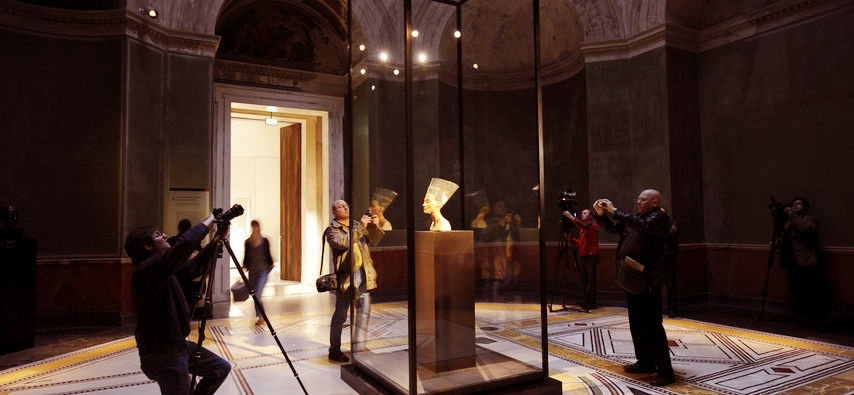
Ich bin ein Berliner (says Nofretete)

Hello, my name is Nofretete, and I was born in Luxor in Egypt. 1912 some archeologists recovered me from this dark grave in the earth and brought me back to light. I, who together with my beloved husband Echnaton were so much fascinated by the divine nature of the sun had to spend 3400 years in the dark. When I was recovered and brought to Berlin, this not only caused a real Egyptomania and Nofretete-cult amongst the ordinary people, but the sun itself started to shine brighter and stronger for happiness to have me back.
Nofretetes bust in the Berlin Neues Museum

The Egyptians were always afraid of my beauty. 3400 years ago they hated my preference of the sun against all the single, little minor gods they were worshipping. Thats why they banned my statue and burried me deep under ground. After the German archeologists under Ludwig Borchardt excavated me 100 years ago in the meter deep dust in Amarna, and brought me back to sunshine, the Egyption authorities several times attempted to get hold of me. They ordered reviews from French lawyers that should proof how the Germans had violated a contract with Egypt and insidiously betrayed them by highjacking me to Berlin. I have to admit, that my escape from Egypt to Berlin did not happened against my own will: Without exchanging words, both Borchardt and myself understood that the Berlin New Museum would provide a more adequate place for me than an Egyptian dust bin. We were afraid that in Egypt, they again would try to hide my beauty from the public views. Now, 2012, 100 years after my rebirth, they introduce in Egypt the Sharia, ordering every woman to hide her face and her beauty. In Egypt, wouldn't they put me under a hijab or a burka, before showing me to the public ? Or will the Salafists who occupied a couple of parlament seats and some governmental posts attack me altogether, destroy me as they did with other statues in Afghanistan and in Mali, because they fear that people will worship my beauty ? In Berlin in the New Museum, people from all over the world come only to see me, and yes, they worship my beauty. They like me, and I like them, and therefore I will stay in Berlin forever. I am nobodies property, I belong to the entire mankind. But in Berlin they toke always care of me, and they will do so forever. During the bombings of the 2. world war, when the city was turned into a ruin field, they found a saver shelter for me somewhere far away in a mountain village. They were so intrigued by Nofretete, that the emperor Wilhelm II and the East-Germans (who lost me to West-Berlin) both ordered identical copies of myself. I am nobodies property, not the Germans and not the Egyptians. But I am and will stay a Berliner. The local people call me a "Berliner Göre", and although this sounds turkish, it is their slang for "naughty little girl". Although this of course is a (typical Berlin) understatement of my beauty, I can life with it.

28.7.12

Modern Cowboy

DOWN IN THE VALLEY Set in the present-day San Fernando Valley, this movie revolves around a delusional man who believes he's a cowboy and the relationship that he starts with a rebellious young woman. Tobe, A young girl, (played by Evan Rachel Wood), is on her way to the beach with some friends, when she falls in love with a modern cowboy, Harlan (played by Edward Norton), who is working at the local gas-station. Tobes father (David Morse) is against the affair between his younger daughter an the elder Harlan. He soon starts an open hostility towards Harklan and even threatens him several times with a gun. When Harlan comes along Tobes house to take her away from the violent father, the two have a short argument during which Harlan injures Tobe with his revolver, from which a bullet is released accidentally. Tobe falls into coma for several days, and Harlan runs away on a white horse together with Tobes little brother. Tobes father starts a hunt and when he finds Harlan, he shots him dead in a tragic show down. Modern Times are not made for romantic modern cowboys.

27.4.12

The magnificance of Irans Nature

Dear Ghazal, Yesterday night the french-german TV channel Arte broadcasted this amazing two-series documentary about the magnificance of Irans Nature. And by chance (or perhaps not really by chance but due to a telepathic link of two like-minded souls), both Omid and myself were watching it. When we met in the morning at coffee break, we were both still out-of-breeze about the beautiful pictures, so we decided that we will travel Omids home-country next summer. In fact he already invited me several times, but I always had some issues regarding the current political tensions between the Regime in Tehran and the West. And Omid convinced me that he will teach me how to get around all hussles there. So we made firm plans for 2013, we will begin the Great Game again. Whats about you, Ghazal, will you accompany us ? It would be so much nicer, and of course we both would take care of you and protect you from the wild creatures all around.

To give you some taste of what will expect you if you come with us to visit the land of your ancestors, have a look at the Arte TV series (you can change the language to german in the tiny menue on the bottom, if you prefer):

The second serie goes to the north and north-west of Iran, visiting the reservation-area Golestan, Elburs Mountains and the Caspian Sea. It also shows peoples visiting Hafiz' tomb in Shiraz and reading his poems with great passion. Rare wild creatures such as Brown-Bear, the beautiful Ghazel, Leopard and Caucasian Deer. The animal photographs of the Serie were shot by Benny Rebel, a gifted expert of animal behaviour and the aesthetics of life.

(You can also watch the two documentaries full-screen size by pressing the tiny rectangular button below the videos.)

7.1.12

A reason to get excited: 19 year old plays Hendrix

Desiree Bassett learned her first guitar rifs at the age of five from her father. Now she is 19 and rocks the Boston areas regular with cover versions of Jimmy Hendrix, Eric Clapton and van Halen songs. She was born 25 years after Jimmy Hendrix' death, but look how she can revitalize his guitar spirit.


I hope it is no big deal for her to learn how to play it with a slightly slower pace, she seems to be in a rush at least at this concert. What I find amazing is to see that you don't have to play left-handed like Mr. Hendrix to get the "All along the Watchtower" right.

8.9.11

Bulgaria and Persia - some common styles in ancient arts

The ancient Bulgarians came to the Balkan peninsula from the south russian and and Kazakh grass lands, were they lived next to skyths. The Partians, i.e. the native persian people, came from the same area and from their brought to Iran the expertise of horse breeding and riding.
But the Black Sea basin, located between the Balkan peninsula, caucasus mountains, norther Anatolia and the Crimean peninsula, was perhaps the earliest site of neolithic settlements. Luigi Cavalli-Sforza, eminent geneticist, anthropologist and linguist located the site of the original proto-indoeuropean language there. An intriguing theory by Pitman and Ryan, based on geologic and archaeologic research even claims that the great deluge (Noahs flood in the old testament, but described much earlier in the epic of Gilgamesh) happened there at around 5600 B.C., leading to a migrational wave of the early agricultural settlements into various directions.
It is thus not difficult to understand that in Bulgaria some historical artefacts, that sometimes are still reproduced in common craftswork, resemble to a large degree the persian-sassanid style.


20.3.11

Schah-Name. Heroic Times.

EXHIBITION IN BERLIN PRESENTS FERDOUSIS "BOOK OF THE KINGS" (opened till June18th 2011)
In 2010 the world celebrated the tenth centenary of the completion of the Persian "Book of Kings". Composed of more than 50,000 rhyming couplets, the "Shah-Nameh" is one of the greatest epics in the history of world literature. It is approximately twice as long as Homer"s epics and 20 times longer than the german "Nibelungenlied". The Persian epic poem covers a phenomenal time span, telling the entire history of the old kings of Iran, from their mythical beginnings right up to the conquest by the Arabs in 651 BCE. The epic was written by the Persian poet Ferdousi (sometimes spelled "Firdausi", 935-1020), who by his own estimation spent 25 years composing the work before completing it in 1010 BCE and dedicating it to the Ghaznavid ruler, Sultan Mahmud (r. 998-1020).


A Thousand Years of the Persian Book of Kings is held by the Museum of Islamic Art in Berlin and the Berlin National Library, to highlight the history of Firdousi's epic magnum opus and its significant role for the Persian national identity.

Shah-Nameh (The Book of Kings) is a classic among epic Persian poetry and recounts Iran's mythical and historical past. It was written in Persian at a time when Arabic was the main scientific and literary language of Iran.

The romance of Zal and Rudaba, the Seven Stages (or Labors) of Rostam, Rostam and Sohrab, Siavash and Soudabeh, Rostam and Akvan-e Div, the romance of Bizhan and Manizheh and Rostam and Esfandyar are among the most popular Shah-Nameh stories.

The exhibition, which will run until July 3, 2011, also displays a rich and extremely rare Sassanid collection of the Museum of Islamic Art, illuminating the historical past of the mythical legends, Artdaily reported.

Visitors will be able to see around 50 manuscripts and folios from the Keir Collection, the National Library, and the Museum of Islamic Art as well as medieval ceramics, textiles, metalwork, weapons, and artifacts from the Sassanid collection.

These are also works on loan from the Berlin Museum of Asian Arts, the Berlin Museum of Ethnology and the Deutsche Historische Museum (DHM) and two German private collections. 
Berlin State Library's Oriental Department and the Museum of Islamic Art have seized upon the commemorations as an opportunity to illustrate the epic's influence in more than 100 magnificent objects, among them loans from the Museum of Asian Art, the Ethnological Museum and the German Historical Museum. The city of Berlin happens to preside over a unique collection of 'Shah-Nameh' manuscripts and single sheets, many of which rank among the most spectacular treasures of Persian book art anywhere in the world. Also on display are examples of decorative art that illustrate the epic's influence on the various areas of daily life in Persia. The exhibition provides profound insight into the world of the great kings and courageous heroes and illustrates just what a central role this piece of world literature plays for the Persian national consciousness, even today.

9.2.11

Darbareye Elly

hi michael,
I did not knew before that UV-light is so essential for our body to produce vitamine D. Interesting aspect, I have to consider this in my PhD-project. So maybe after UV-exposure my TK60 cells are really better off, cause they finally get some vitamine D after living for too long time in the dark incubator ? ;-) And what do you say now: Last year you have been wondering why I prefer to walk home instead of taking the bus. I then told you it is very relaxing for me, cause this way I can let my thoughts flow freely. Now it appears that I intuitively might have known that it is really healthy to spend some time out in the open to reconstitute my vitamine D reservoir.

I already saw the movie "Darbareye Elly" (what means "All About Elly", but the original title in persian is "Kanojo ga kieta hamabe")  about two years ago, after it received the Silver Bear Award at the Berlin film festival. But I watched it again yesterday with Shava.

I liked the movie, although it was no easy entertainment. It had no Happy End, but a Tragic End.
The story starts very relaxed, showing three young families (including Ahmad, brother of one of the women, who just came from Germany where he divorced) spending a weekend at a seaside cottage at the caspian sea. The three families have the silly idea to bring together the lonely Ahmed with the baby-sitter Elly, although they know that she is engaged with another man in Teheran. Whereas all the three couples and Ahmed start to make stupid jokes about this plan, laugh about Elly when she is not around and all appeare very superficial to me, Elly herself is much more closed. She is a girl with some mysteries, she keeps secrets and does not like the continious jokes about the attempted matchmaking a lot. She tries to do the job that she was officially hired for: looking after the little kids of the three families. She frequently calls her mom, who is ill, and after one day she decides that it is better to return to Teheran. The three couples don"t want to let her go, they hide her luggage and her mobile phone. She says that she has to leave and would even walk home. The three couples and Ahmad ignore her and start to play Volleyball and go shopping. Elly helps the kids to fly a kite, but suddenly one of the little boys falls into the water and almost dies. The three man, interrupting their game get panik and jump into the sea, so finally the boy is rescued. But after some minutes they recognise that Elly is missing. And suddenly, the relaxed relationship between the three couples and Ahmed turn into aggression and hate. Everybody accuses the others of beeing responsible for the desaster.

After one day, indeed Ellys dead body is found in the sea: She obviously died while trying to rescue the little boy. The three couples now have to inform some relatives of Elly about the accident, and they can only find Alireza, the man to whom Elly was engaged since three years. They find out his telephone number and ask him to come, claiming that Elly is just ill. When he arrives at the site, finding out that she in fact died, he breaks down. The three couples don"t want to admit that Elly was only invited to this weekend trip to match her to the divorced Ahmad. They try to make Alireza believe that Elly was hired exclusively as a baby-sitter. So they want to get around the conflict by adding more and more lies on top of each other. You can feel how their only concern is to get away with their responsibility.

I think Asghar Farhadi, the movie director, tried to show that this practise of organized partnerships for young family-members is highly questionable and it bears the seed for a tragedy. It is based on the arrogant idea that relatives know best what is good for their son or brother or daughter, and they can easily find a suitable partner using their own judgement. It is obvious that Elly hates this, since she is not sure about her 3 year long engagement with Alireza. But the three stupid couples and Ahmad think that they have the right to interfere with her emotions. They make unpolite jokes about Elly, they lie, and they dont respect her privacy. They are too superficial to see that Elly is full of doubts about her future, and that she does not want to be pushed into a new relationship. She has thoughts that are not for the public, emotions that she does not want to show around.
At the end, this stupid idea of pushing two person together leaves behind two victims: a physical one (Elly, who dies) and her former boyfriend Alireza (who breaks down emotionally). The bad thing is that the three couples continue to lie to Alireza although they see how much he suffers from Ellies death: They tell him that Elly knew from the beginning that the weekend-trip with the three families was intended to bring her together with Ahmad. By this lie, the three couples so cruely leave the mourning Alireza believe, that his girl-friend Elly was searching for an easy adventure with another man. But Elly, in fact, never agreed with this, she said she only joines the company to look after the kids.

I would like to hear what you think about the movie.
take care
/ghazal

------------------------------------------------------

Ghazal my Dear,
Tonight I went to see the movie "Darbareye Elly". It was shown in one of the very small cinemas here, which are specialized on Arthouse movies.

Although you had told me already a lot about it before, it was nice to see it. After the first 5 minutes of the movie, however I thought that we might talk about two different things, cause it started so nice and relaxed, when they drove through the tunnel and all were just shouting for fun. And then they had this short stop-over at a small river, and I immediately recognised the russian Samovar, because we have exactly the same one (as part of a big collection of even older ones). And in the beach cottage, I recognised the old russain fridge, type "Wolga", cause we have the same one in our cottage in Bulgaria. So initially I was a bid distracted by pictures, also had problems to follow the subtitles and at the same time understand the relationship between all the characters and their names (you should have provided me with a sort of set-list of all character and who is married to whom and which kid belongs to which couple). Anyhow, after a while I got the impression that all the seven characters are interchangeable, they looked differently but acted similar. The only exception was Elly, who was mysterious. When she disappeared after the accident with the boy I was hoping for about an hour, that she might not have died in the sea, but just left the place to escape the silly jokes and the attempted match-making. When she was eventually identified in the mortuary it was really sad and I was almost ready to leave the cinema.

Elly reminded my a lot of you, Ghazal. She was also calm and the exact opposite of the loud and superfiscial society around her. She had secrets, that she wanted to keep for herself. She had an aura of pride and aristocracy, which stoud in sharp contrast to the other characters who never thought about the right of privacy or secrets. It is a pitty that it was Elly who died in the movie. I so much wished to see her finding a new live, deciding about her own future, to stay strong and nice and get happy.

As usual , I wish you all the best, success with the project, happyness in daily life but also exciting dreams.
Take Care, Ghazal.

Michael
19.1.11

Relax with a kinetic sculpture

Hi Ghazal my Dear,
Reading you last e-mails I got the impression that you are most excited if I send you links to some "moving pictures" (the origin of the word MOVIE, as you perhaps know). The german translation is KINO, which comes from french CINEMATOGRAPH, meaning "moving or kinetic image" and what gave rise to the english CINEMA.

Why I tell you all this stuff ?  Not only because I remember the films we saw together here in Munich, and the nice time we had before and afterward.
There is another reason, and this I discovered last weekend at the BMW museum (can"t remember if you went there with your family or with Shava). Perhaps the most impressive object in the museum is the so-called "kinetic sculpture", an arrangement of steel balls hanging on wires that can all be individually moved up and down by a machine, thereby generating the most astonishing images of slowly moving 3D-sculptures.


I am almost sure, Ghazal, you will like this. And I am also sure that you work hard these days, same as you did during your MSc project here, and therefore you deserve some relaxing videos at night.
Enjoy, Take Care

Michael

As always, I hope you are doing fine and stay as nice and symphatic and strong as you have always been.

PS: Had a look at the swedish word for cinema, and this is Bioskop. No clue what "Bio" means therein. There is a type of apple, which is called Boskoop, but this I guess is a coincidental similarity. And Cinema is written in Persian as
سينما
And here, you see, I don"t even know how this is pronounced. So many things I have to ask you.