NOTE:

Dear visitor (if there is any) please note the following: The blog "Broken Radius" is hosted at Google Blogger's server. I can therefore not guarantee that your visit to the blog or any comment you write wont be recorded by the NSA. If you have any worries about this, you can visit instead my alternative blog Letters-to-a-Persian-Cat. This one is hosted at a European server which hopefully acknowledges visitors privacy.

24.9.13

Harvest Time

Watching my tomatoes now, 4 month after I starting them from seeds in early May, I realize that I have really neglected my blog without any obvious reason. Plenty of work is a bad explanation, I agree, since I never liked the idea to sacrifice everything in life for commitments at my job.
But at least for the tomatoes, there was not so much to report over the last month. They quickly grew, developed their defence against the snails, drank a lot of water (which unfortunately was abundant this year from rain), developed tiny, unspectecular blossoms, where the pollens managed to fertilize the carpels by wind or - most likely - assisted by our dog wagging his tail against them (I will soon write a wikipedia article explaining in detail "dog-tail pollination").
Finally, they all developed fruits, although only few of them fully ripened until now, late September. Although it is still sunny weather, I guess the riping program stoped because it is not warm enough any more in the morning.
Here are the pictures of the different variants.

 
   1:  Oxheart-tomatoes (Bulgaria)


 2:  Cocktail-tomatoes (Italy)

  3:  Egg-tomatoes (Germany) 

 4:  Austrian Monster-tomatoes (Germany/Austria)

  5:  Cherry-tomatoes (Israel)

                                No picture (young plants were eaten by snails, perhaps weak pest defence)
 6:  Vine-tomatoes (Hungary)

 
It's a pitty I started too late with the plantation this year (Early May). Therefore, although 2013 in general was a very good tomatoe year with almost no fungi or mold, lots of the berries remained green. I will collect their seeds for next years culture. 
I was completely amazed to see that although all seeds I planted this year were pealed from tomato berries  bought in supermarkets or picked from restaurants salad bars, the new generation plants grew pretty strong and the fruits resembled to a large degree the shape and size of last years generation. I had expected much more deviations from the parental generation and more inbreeding surpression, because of the genetic shift in the F2 intercross and loss of heterozygosity.
The few fruits that became red now in late September were no doubts much more delicious than every tomato one can get in the supermarket.

The green ones from above turn red after 2 weeks in the house. Although they missed the sun during ripening, they still topped the standard supermarket tomatoes in terms of taste and varigation.

 T

20.9.13

The way to catch your audience' interest

At the annual Mouse Molecular Genetics conference at the Sanger Center in Hinxton. Some of the presentations seem to attract more attention by the audience than others, and this not only depends on the originality of the subject or the wealth of novel results. Not completely unexpected, speakers also had quite different presentation styles. Some were giving their presentation while looking towards the audience and only turn towards the overhead slides behind them if necessarry. Others talked for 15 minutes while cosistently turning away from the audience, showing them mainly the backside of their had. One could get the impression as if they are talking to themself or to their slides. Not only performing artists and musicians know quite well that in order to catch the audience' attention its crucial to show them your face. Even politicians understoud meanwhile that if they present a speech to the public, and they have to read the speech from a script, its better to read it from a half-transparent mirrow, still allowing them to look into the eyes of the audience. Its a pitty that only at scientific meetings you still find this unpolite habit of turning the face away from the audience.

Two examples of speakers who permanently turn their face away from the audience, thus failing to build a good relationship with the people in the lecture hall.


 These scientists did it beter by looking most of the time towards the audience.

29.8.13

Holy Christ for Gods sake

Today at the beach in Albena at the Black Sea, a boy slipped and fall on a jelly-fish. When I searched in Google for the proper expression of such a misfortune, it suggested "slip on a banana skin" as the most popular search term. And for this, the top rank picture must have been one posted by Richard Dawkins or the late Christopher Hitchens.

Needless to say I like it as well, makes Christ in my eyes much more sympathic. And by the way, I always thought that his martyrdom at the cross was a legend. In fact he died from drowning when we wanted to proof he can walk over the sea.

20.6.13

Natural born Liars

Hi Michael, do you know who are the greatest liars in history ? The founders and representatives of all the different religions on earth made lying their biggest job. Whether they do it with purpose or because they don't know any better, that does not make a difference. But promoting lies is their natural business. Although their followers become less and less over the centuries, their bad seed still causes enough harm and tragedy.
Take Care
/Ghazal

31.5.13

Tomatoes - from all around the world


Dear Ghazal, I think one of the best souvenirs one can bring home from a journey are plants. Knowing how easy it is to grow tomatoes from seeds, I am constantly on the hunt for some variants from other countries. In particular I like to collect the seeds from the ripe fruits themself, be it from a salat dish in a mediterranean restaurant, be it from an oriental vegetable market or from a small garden in a suburb village. 
After stripping the seeds from its viscous cover using a piece of tissue paper and drying them quickly between some sheets of a newspaper, they can be stored till next spring. Ideally, I remember the stored seeds in February or March, rehydrate them over night in some ml of water and put them about 5mm deep into a shallow box with garden soil. The box can be left under a plastic foil to keep it moist on a warm and sunny place behind the window (I prefer to place them on my office window). After a few days, one should see the first sprouts and than they grow quite fast, which requires the plastic foil to be removed. Since they start to consume water now from the soil and without the plastic foil there is also more evaporation, the box should be checked daily and if necessary, watered. 
Below shows the box after 3 weeks. I had seeded 6 variants of tomatoes, which are (from top left in clockwise order: 
1:  Oxheart-tomatoes (Bulgarian farmers market)
2:  Cocktail-tomatoes (from vegetable salat, Tratoria, Vietri-sul-Mare)
3:  Egg-tomatoes (Penny supermarket, Munich)
4:  Austrian Monster-tomatoes (stolen from my neighbours garden, Munich)
5:  Cherry-tomatoes (Carmel Market, Tel Aviv, Israel)
6:  Vine-tomatoes (Made in Hungary, Aldi supermarket, Munich)

6 tomato variants, 3 weeks after planting seeds.


At this stage one could already see that they grow so dense, that one has to single them out and give each plant some more space. It is crucial at this stage of plant development that each sprout gets sufficient space underground to develop strong and dense roots. This gives them the best condition to withstand drought and resist parasites when they are later transfered out into the garden.
But at this stage it became also obvious that the 6 tomato variants which were collected from locations in different countries had considerably different growth rate. No.6 (Hungarian Vine-Tomatoes) were not growing at all, No. 2 (picked from an salat bowl at an Italian Tratoria) was growing weak.

After pricking them and transfer a single plant from each variant into one large pot, they look as shown below (note that the plants below and above are the same age. Below after 5 days growing separatly, above those which grew the entire 3 weeks together).

Tomatoes from above box, pricked and grown separately for last 5 days. (red cross: tiny plant, variant 5, from Tel-Aviv Carmel market.
Although the tomato is a typical new world plant, meaning it found its way to the European and Asian continent only after Columbus "discovered" America, they became so widespread here that people gave them quite different names. By the way, the offical latin term for tomatoes, Solanum lycopersicum has some indirect relations to Persia. The scientific species epithet lycopersicum means "wolf peach", and comes from German werewolf myths. These said that deadly nightshade (Solanum) was used by witches and sorcerers in potions to transform themselves into werewolves, so the tomato's similar, but much larger, fruit was called the "wolf peach (in German: Pfirsich aka Persian)" when it arrived in Europe. The Aztecs called the fruit xitomatl (pronounced [ʃiːˈtomatɬ]), meaning plump thing with a navel. Most western European languages derived their names for "tomato" from the native-americans Tomatl. The Italians introduced their own term: pomodoro (from pomo d'oro "apple of gold"), and this was also borrowed into Polish and into several other slavic languages. A funny and sometimes confusing convention is found in Russian language, where the plants and the fruits are called "Pomidore", but the juice squeezed from them is called "Tomatnij sok". Also, the Germans had a historical unique name for them: Paradeisapfel (for "apple of paradise", which by the way is another cultural link to Persia, since Paradise originates from the Avestian terms "pairi.daêza", meaning a piece of land surrounded by a wall). Not very common in Germany any more (except in historical cooking- and gardening books), a derivative of it, Paradeiser is still used in the Bavarian and Austrian dialects, and was borrowed from there into modern Hungarian, Slovenian and Serbian.

10 days later, all plants grown very well. I have to transfer them quickly to the garden, before they start blossoming.

29.5.13

The Dark Side of Humor: Seizure induced by Laughing


Dear Michael, well, didn't we found agreement at least on this very subject:  that however difficult life might be and how long it can take before our efforts in research pay out, threre is always one measure to keep us from giving up. I am talking about human laughter. And it was not only Aristoteles who described human laughter as devine, but it was also identified in several medical studies as promoting health, protecting from various diseases and extending longevity.  I remember when we were riding on the bike through Munich, and you pushed me forward, I felt I should protest against this but in fact I could not, but instead I fell into laughter instinctively. And you said "12 laughters a day keeps the doctor away" ?  And I thought that at least for short term you were right, and it made me feel happy.
But now I red this article in the peer-reviewed Journal of Medical Case Reports (Impact factor 0.4), entitled "Laugh-induced seizure: a case report" by MR Mainali et al from the Health System Department of Medicine in Reading, Pennsylvania. The patient, a 43 caucasian men suffered from "...multiple episodes of seizures, all induced by laughter while watching comedy shows..." (hic!) The patient described the conditions himself as following: "... I started laughing, then my arms started shaking and I felt like my consciousness was being vacuumed away... ". Now I became suspicious, whether I am suffering from the same symptoms. I don't mean that I felt my "...consciousness being vacuumed away..." those days on the bike in Munich, but my arms indeed started to shake a bit when you pushed me forward, and I lost control over the bikes handlebar. So it might have ended dangerous indeed, at least in this situation on the bike.
The authors of the study tested several treatments to help the poor man. The anti-convulosant drug Carbamazepine appeared to prevent the seizures for several month, but according to the FDA this drug has several potential side effects, in particular onto the unborn child of pregnant mothers. The authors concluded in their study that the safest measure against the seizures is by preventing all laugh-inducing situations.  I have to admit, since I started my PhD here in Stockholm, the frequency of laugh-inducing moments went down a little bit. I think to benefit from the healthy effects of laughter, I should instead expose myself intentionally to some extra laugh-inducing situations. As the authors very firmly state at the end of their paper, "... Smiles and laughter are universal human social gestures that involve a complex sequence of facial, pharyngeal and diaphragmatic muscle contractions and help to establish a friendly interaction with other people."  Unfortunatly, they don't make any suggestion about the Comedy that was so efficient in their patient to make him Rolling-on-the-Floor-Laughing.

Take Care, and keep smiling
/ghazal


9.5.13

Going North

Dear Michael, next week a scientific workshop on "Epigenetic factors in Radiation Biology" will be held at stockholm University. I am involved in its organistion. I'm wondering if you will attend the meeting ? Some really good speakers were invited, and I think it'll be fun.
Take Care /ghazal
--------------------------------------------------------------- 
Ghazal Dear, Thanks a lot for the information. I already received an invitation to the workshop a couple of month ago from M. But I decided to send Y. to present our studies there. You know my reservations to travel to northern countries. In fact there would be only three cases that would be worth for me to visit Sweden:
- A reunion concert of ABBA,
- they award me the Nobel price
 - (I tell you later).
good luck with the meeting Michael

2.5.13

Space Messages

Hi Michael, I recently had to remember your permanent speculation about extraterrestrial planets with habitable conditions suitable for you and an angel from outer space (and a horse). What you might have never considered, that the meteors we were observing in August some years ago might in fact carry some information on the living conditions at the planet from which they originate. 
When we were spotting some of these "Stjaernfallen" from the Persides meteor shower, I was amazed by their sheer existence and finally I defeated my initial doubts. It was a great moment when one of the meteorites apparently approached us head on, and to watch this rare event it was worth to spent half of the night out under the sky. 
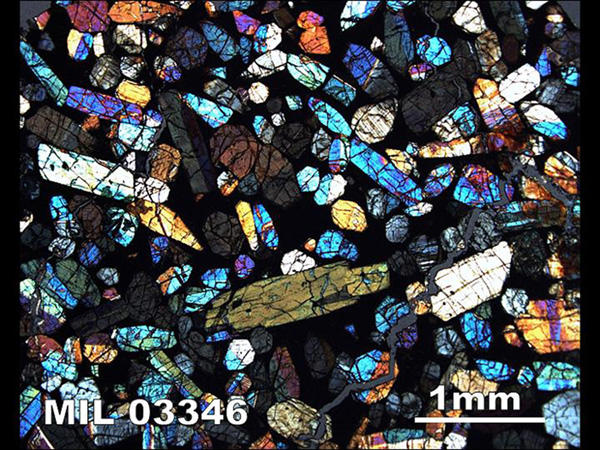
And now scientists found out that some of the meteorites that don't burn completely in the atmosphere, but reach the earth surface, might serve as informative messengers from extreterrestrial planets and tell us something about how habitable the living conditions might be there.

Microscopic picture of the crystaline structure of a mineral from a meteorite supposed to be of Mars origin

The meteorites that we can see regularily on the night sky, with the highest incidence in August (Perseides) and in November (Leonides) not only gives us the chance to express our deepest wishes, but as researcher from Michigan State University recently discovered also contain mineral and chemical signatures that can signify habitable conditions on the planet from which they originate, such as the presence of water. But they also mentioned that "the trouble is by the time most of these meteorites have been lying around on Earth they pick up signatures that look just like habitable environments, because they are. Earth, obviously, is habitable.
Thats good to know, don't you think so ?

Take Care,
/ghazal

29.4.13

Signs on Grass

I first thought that these signs on the fields between Munich and our Lab were traces of the flying spaghetti monster. But they could also be clandestine messages by some omnipresent intelligent power from the 5th dimension. An almost unambigous evidence for the latter: When I drove by on my way home, my bike tyre went flat right at this place and I was forced to stop. So on this occasion, I captured the most weired of the Grass Signs and tried to interprete them: 


Dancing Fool

Cupid, lay down your bow ...


Modern Silkroad

On the Dancefloor

Stony Kiss


Troika Invasion


A huge step for the mankind


The "omnipresent intelligent creature" who draw these figures were in fact mice. And the lines are paths they used during the last 4 month under the snow. Now that winter is over, the snow cover is gone, and the mouse paths have no use any more.