NOTE:

Dear visitor (if there is any) please note the following: The blog "Broken Radius" is hosted at Google Blogger's server. I can therefore not guarantee that your visit to the blog or any comment you write wont be recorded by the NSA. If you have any worries about this, you can visit instead my alternative blog Letters-to-a-Persian-Cat. This one is hosted at a European server which hopefully acknowledges visitors privacy.

6.2.13

Are we Stardust ?

Dear Michael,

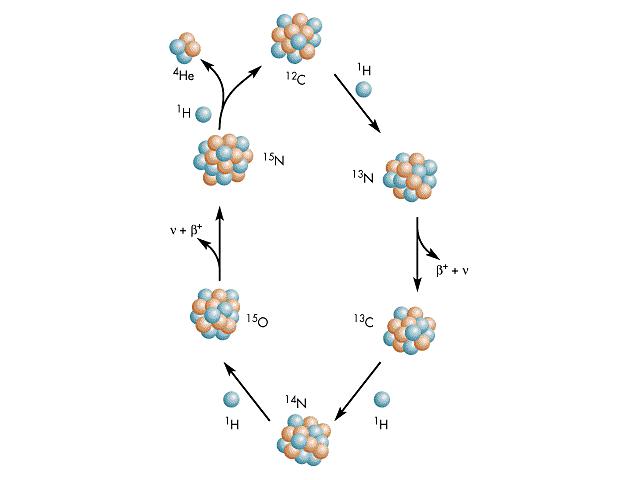
All the big stars, i.e. those with a mass exceeding the sun's mass by a factor of 1.3, gain most of their energy by a hydrogen-fusion reaction that involves a catalytic cycle, known as the Bethe-Weizsäcker or CNO-cycle.

During this reaction cycle, protons (i.e. hydrogen nuclei) are added four times into a cycling reaction that converts carbon through various nitrogen and oxygene isotopes back to carbon, while releasing helium as the net reaction product and, of course, the enormous amount of energy which fuels the star.

CNO cycle

This cycle in its logic resembles the citric acid cycle, during which all aerobic organisms convert energy from nutrients (i.e. carbohydrates, fat, and sometimes proteins) into ATP. Similar to the Bethe-Weizsäcker cycle, successive transfer of protons (in this case released from water) are an important feature of this energy conversion.

But beyond this similarity in the reaction cycle, the CNO-cycle (providing stars with their enormous energy) and the citric-acid cycle (providing energy to living organisms) are connected by a much more fundamental link: The Bethe-Weizsäcker CNO cycle is the first reaction in the formation of our universe that produces Oxygene and Nitrogene from Carbon and Hydrogene (Carbon is directly produced by 3-alpha fusion of Helium nuclei). And it is these three elements, namely Carbon, Oxygene, Nitrogene and Hydrogene, that are the basic elements of all living matter. All Carbohydrates are made of C, H and O, as are all fatty acids. All proteins are made of C, H, O, and N (with a trace of Sulphur). And essential element that is missing is Phosphorus, an integral constituent of DNA and RNA. But in molar amount, it is much less than C, H, N, and O.

So we have to acknowledge that the main constituents of our body (and of any other living organism as well) were a by-product of the stars engine.

Or as Crosby, Stills, Nash and Young put it in their songs lyrics:

We are Stardust

Well I came upon a child of God, he was walking along the road And I asked him tell where are you going, this he told me: (He) said, I'm going down to Yasgur's farm, going to join in a rock and roll band. Got to get back to the land, and set my soul free. We are stardust, we are golden, we are billion year old carbon, And we got to get ourselves back to the garden.

Well, then can I roam beside you? I have come to lose the smog. And I feel myself a cog in something turning. And maybe it's the time of year, yes, said maybe it's the time of man. And I don't know who I am but life is for learning. We are stardust, we are golden, we are billion year old carbon, And we got to get ourselves back to the garden.

By the time we got to Woodstock, we were half a million strong, And everywhere was song and celebration. And I dreamed I saw the bomber jet planes riding shotgun in the sky, Turning into butterflies above our nation.

We are stardust, we are golden, we are caught in the devil's bargain, And we got to get ourselves back to the garden

-------------------------------------------------------------------------------------------------

Ghazal, my Dear, I always believed that you came from another star. What you wrote above shows that you brought from there some interesting ideas with you.

Take Care, my Dear

Michael

PS: I think we also have something in common, in our dialogue that is going on for about 3 years now. Whereas I always tried my best to misunderstand you, to fill the empty spaces in your messages with a meaning that perhaps was never there, you in contrast always managed to not understand anything from what I wrote. When I imagined that there are words between the empty spaces in your letters, you decided that the long sentences from me were void of any meaning. How long can this go on ?

30.1.13

PS: Codex Amorum Retardum (germ.)

Eine Theorie besagte, dass seine besondere Verbindung zum Iran und seinen Menschen auf ein fast 25 Jahre zurückliegendes Ereignis zurück ging, von dem aus allerdings eine Verbindung bis in die Gegenwart reichte. Damals war Deutschland und die ganze Welt noch strikt getrennt in Ost und West. Er lebte auf der östlichen Seite des sogenannten Eisernen Vorhangs und hatte eigentlich nur Politik im Kopf. Seine Doktorarbeit im Institut für Krebsforschung machte eigentlich immer nur dann einen Schritt vorwärts, wenn gerade keine Untergrund-Versammlung, kein Treffen mit oppositionellen Schriftstellern oder Malern oder keine Reise zu irgendeinem illegalem Konzert auf dem Programm stand. Weil man aber selbst dafür nicht ganz ohne Geld auskam, und weil das Doktorandengehalt ziemlich mager war, arbeitete er an den Wochenenden oft in Berliner Restaurants als Kellner. Einmal, es war ein Sonntag und noch ziemlich früh, etwa gegen 8 Uhr, bediente er dabei in einem Ost-Berliner Bahnhofscafe eine iranische Familie, die gerade mit dem Nachtzug aus Schweden angekommen waren. Sie lebten dort als politische Exilanten und waren jetzt auf dem Weg nach Westberlin, wo sie Freunde besuchen wollten. Offensichtlich hatten sie die nächtliche Zugfahrt nur auf einfachen Sitzplätzen verbracht, und sahen dementsprechend unausgeschlafen aus. Das fast noch menschenleere Bahnhofs-Cafe mit seinen pompösen Polstersesseln schien ihnen eine willkommene Gelegenheit zu sein, um sich selbst und ihrer gerade dreijährigen Tochter, die sie offensichtlich während der ganzen Fahrt eng an sich gepresst hatten, endlich eine Pause und etwas Erholung von den Strapazen der Nacht zu gönnen. Sie hatten es anscheinend nicht sonderlich eilig, um über einen der wenigen Checkpoints in den Westteil der Stadt zu gelangen. Als er mit ihnen ins Gespräch kam amüsierte es ihn anfangs, dass sie sich trotz der hinter ihnen liegenden strapaziösen Nacht sehr interessiert an den Einzelheiten des Leben im Sozialismus zeigten. Es war klar, dass sie sich theoretisch sehr ausgiebig mit dem Kozept einer klassenlosen Gesellschaft und der Idee von der Gleichheit aller den Menschen befasst hatten, aber ihre Vorstellungen glichen denen, die sich kleine Kinder vom Schlaraffenland machten. Gleichzeitig aber strahlten sie aber eine tiefe Traurigkeit aus, weil sie ihre eigenen politischen Träume mit der Vertreibung aus ihrer Heimat bezahlt hatten. Sie gehörten zu den Iranern, die zehn Jahre zuvor gegen den Schah opponiert hat und die Monarchie gegen eine demokratische, sozialistische Gesellschaft austauschen wollten. Als der Aufstand der Volksmassen tatsächlich zum Rücktritt des Schahs und seiner Flucht aus dem Land geführt hatte, wurden ihre Träume aber sehr schnell von einer brutalen Wirklichkeit eingeholt. Die Macht über das Land fiel in die Hände einer konservativen Clique von islamischen Geistlichen und sogenannten «Rechstgelehrten», die schon bald alljene brutal zu unterdrücken begannen, die vorher aus ihren progressiven, demokratischen Idee nie ein Geheimnis gemacht hatten und die Zukunft ihrer Heimat in einer Art Volksdemokratie sahen. Jetzt wurden alle Vertreter dieser progressiven Bewegung, die den Kampft gegen die Macht des Schah angeführt hatten, Mitglieder der Tudeh Partei, linke Journalisten, allzu säkuläre Universitäts-Gelehrte, Künstler und Schriftsteller verhaftet, mit fabrizierten Anschuldigungen vor islamische Schnellgerichte gezerrt, in das berüchtigte Gefängniss Evin geworfen oder oft genug gleich hingerichtet oder heimtückisch ermordet. Die Erfahrung, dass die eigenen politischen Aktivitäten von Kräften missbraucht werden können, denen man später selber zum Opfer fällt, dass man also für die eigene Tragödie am Ende vielleicht das eigene Handeln und einen naiven Idealismus verantwortlich machen muss, hatte die beide offensichtlich schwer traumatisiert. Sie sagten, dass Sie seitdem keinen Sinn mehr in irgendwelchen politischen Akivitäten sähen, und dass ihnen hier in Europa sowieso die Orientierung fehle, weil die Parteien ja sowieso fast austauschbare Programme hätten. Sie zeigten voller Stolz auf ihre Tochter Ghazal, deren blaue Augen, da waren sie ganz sicher, auch später ihre intensive Farbe nicht verlieren würden. Sie sagten, dass ein Kind und eine glückliche Partnerschaft viel wichtiger sei, als der Drang nach politischer Verwirklichung, und dass politische Aktivitäten eigentlich immer basieren auf dem Hass oder zumindestens der Ablehnung und Verachtung des Gegners. Er sah das damals irgendwie anders, für ihn hatten diese politischen Aktivitäten gegen das ostdeutsche Regime nicht zuletzt eine sportliche Note. Er war ganz begierig darauf, die Polizei, Parteiapparat, Sicherheitsdienste, die von vielen samt und sonders verachtet wurden, immer wieder herauszufordern. Nachts Parolen an die Wände zu schreiben, Flugblätter zu verteilen, bei Konzerten unseren Unmut hinaus zu schreien, das machten er weil man sich dafür auf einem inneren Aktivitäten-Konto bestimmte Erfolgspunkte sammeln konnte. Und irgendwann haben das wohl immer mehr Menschen im Osten so getrieben, denn der sozialistische Musterstatt fing erst langsam an auseinander zu bröckeln, um dann plötzlich wie eine schon innerlich völlig morsche Ruine, die nur noch von Putz und Tapete zusammengehalten wird, innerhalb weniger Augenblicke in sich zusammen zu fallen. In den Jahren danach musste er noch oft an die iranische Familie denken, denn auch er verliess seine Heimat nachdem der Eiserne Vorhang verschwunden war. Er ging ins Ausland, weil sich die politischen Veränderungen in Deutschland 1989 als nicht sehr förderlich für die weitere berufliche Entwicklung eines jungen Wissenschftlers erwiesen. Im Osten herrschte das pure Chaos, die Institute und Unis wurden geschlossen oder warfen gute Wissenschafter einfach raus, und im Westen Deutschlands gab es bei Bewerbungen auf die guten Forschungs-Stellen auch keinen Bonus für die armen Brüder und Schwestern aus dem Osten. Da ihm aber solch ein Status auch höchst unangenehm gewesen wäre, machte er sich lieber auf, um in England und Holland die Wissenschaftslandschaft zu erkunden. Sicherlich nicht so schwer desillusioniert wie die persische Familie kam es ihm doch immer mehr so vor, als wäre durch die von ihm ja immer herbei gesehnten Veränderungen zu Hause nur ein anachronistsches Gesellschaftsmodel gegen ein anderes ausgetauscht worden.

Viele Jahre später, als er schon lange wieder zurück in Deutschland war, und an der Uni und einem Forschungsinstitut Studenten unterrichtete und ihre Forschungsprojekte betreute, sass ihm plötzlich eine junge Frau im Seminarraum gegenüber. Ihre tief-blaue Augen standen in einem unwirklichem Kontrast zu ihren dunklen Locken, und als sie ihn nach der Vorlesung fragte, ob sie in seinem Institut ihre Master-Arbeit machen könnte, und sich vorstellte als Ghazal aus Schweden da wurde ihm klar, dass hier die Tochter der iranischen Familie vor ihm stand, mehr als 20 Jahre nachdem er sie auf den Armen ihrer Eltern in dem Ostberliner Bahnhofscafe liegen sah, und ihr Vater versucht hatten zu erklären, dass nur die Liebe zu ihrer Tochter Ghazal sie vor den politischen Irrlichtern retten und etwas Trost finden lassen würden, nach all den Erfahrungen der Sinnlosigkeit des sozialen Kampfes. Ghazal war ganz anders als ihre Eltern damals ein Mensch, den keine Selbstzweifel erschüttern konnten. Ihre Eltern schienen sie immun gemacht zu haben für die Versuchungen der politischen Tagträumerein. Aber sie wurde auch für ihn, ähnlich wie für ihre Eltern 20 Jahre zuvor, die Rettung in einer Zeit der Ungewissheit. Er merkte rasch, dass Ghazal ihm viel mehr bedeutete als nur das Bindeglied zu früheren Freunden. Er spürte immer mehr den Wunsch, nicht nur im Institut ihre Forschungsarbeit zu betreuen und ihr die Konzepte und Methoden der Genetik nahe zu bringen, sondern auch die Abende und halbe Nächte mit ihr zu verbringen. Er hatte das Gefühl, dass er nur wegen der politischen Zustände und Verwerfungen in Europa und Deutschland 20 Jahre des Lebens verpasst hatte, um mit Ghazal zusammen zu sein, und dass er das jetzt alles nachholen könnte, dass alles, was er in der Zeit seit dem Treffen mit ihren Eltern im noch geteilten Berlin erlebt hatte, fremde Länder, Bücher, Entdeckungen, verrückte Menschen, dass er all das jetzt zusammen mit ihr noch einmal erleben müsste. Dieser Wunsch, für Ghazal mehr zu sein als nur ein wissenschaftlicher Betreuer, sondern auch ein Freund und Vertrauter und vielleicht Geliebter, war sehr utopisch. Es ist nicht einfach zu sagen, ob er mit diesem Traum gescheitert ist, genauso wie Ghazals Eltern mit ihrem Traum eines sozialistischen Irans gescheitert waren, denn er hatte mit ihr einige der aufregendsten und schönsten Momente seines Lebens. Aber ab einer bestimmten Stufe konnte nur seine Phantasie das liefern, was die Realität einer Beziehung zwischen einem End-40er und einer Mitt-20ger nicht mehr erlaubt. Jedoch erweisst es sich, das die Traum von einer besonderen Liebe ungleich hartnäckiger ist als der Traum von einem besseren politischen System. Während der allmorgendliche Blick in die Zeitung genügt, um sich jegliche politische Träumerei fahren zu lassen ist es mit einer unerfüllten Liebe nicht unbedingt so. Du wirst ja nicht per Eilmedlung davon unterrichtet, dass Ghazal sich zum Beispiel mit irgendeinem Björn oder Reza oder Carl-Gustav verlobt hat. Vielleicht hielt sie es ganz bewusst geheim, so wie sie seit Jahren immer nur von Ausflügen oder gemeinsamen Stunden mit Freundinnen berichtete, und sie auch auf Fotos immer nur mit Verwandten oder weiblichen Kollegen zu sehen ist. Hatte sie überhaupt irgendwelche Träume, oder entschied sich ihr Handeln nicht vielmehr in der Unterscheidung zwischen Vernunft und Spielerein ? er würde wohl nie erfahren, ob das halbe Jahr, dass sie zusammen verbracht hatten, für sie eher eine vernuftige Entscheidung war, oder einer ihrer raren Ausflüge in die Welt der spielerischen Verrücktheiten.
28.1.13

Freezing Moon

Ghazal my Dear, I felt sorry for this nice big moon tonight, 'cause he seem to be freezing up there. You can see from the blue shine on his cheeks how cold he must feel. And he was shivering so much, that the picture I did of him appeared to be not very sharp. freezing moon Take Care, Michael

27.1.13

The Empress and Me - Farah Diba in the eyes of an exiled Iranian Filmmaker

Nahid Persson-Sarvestani, a former activist of the student branch of the Tudeh party and in the late 70s among the demonstrators against Shah Reza Pahlevi, now lives in Sweden as a film-director. In her 3 parts documentary, she interviews Farah Diba, the last empress of Iran, who now lives in exil in Paris.

part 1

part 2

part 3

Farah Diba speaks with a broken voice, and Nahid Persson, although with a politically active background, seems to be more interested in the private life of the Shahs widow. The Shahbanou, however, is a professional when it comes to any media contacts. She only repeats the details of her life with the Shah, how they first met, how Reza Pahlevi asked her to become his wife - stories, she already told too often to be published in the yellow press. Sometimes, Farah Diba tries to shift the conversation more into a political and historical context, asking Mrs. Nahid Persson-Sarvestani on which side she was on during the 1979 revolution, the communists Tudeh people, or the peoples Mudjaheddin, or the violent islamists of the Fedajin. Persson apparently fears a clear confession at this point, since the blunt anti-Shah activities she was involved in prepared the ground for the most inhuman, hypocrite and stupid regimes ever seen in recent history: the so-called "Islamic Republic of Iran". So these two woman who 35 years ago were on opposite sites of the battle line in pre-revolutionary Iran, now find them self in exile, one in Paris the other in Stockholm, and both see with bitterness their lost dreams. If the two would be ready to give up their wounded pride, maybe they would find out how much in common they had in their youth. Both were dreaming of a modern and liberal society, with secular education, open to the rest of the world, liberated woman and social and economic prosperity. But each of the two, the aristocrats and the socialist, both were wrestling for leadership in this movement. And both were loosing everything. What arose after the Shah and his family had to leave in 1979, and the Tudeh for a short moment thought their triumph is in sight, was the worst nightmare of an extreme conservative, religious, anachronistic and brutal dictatorship of uneducated and corrupt Mullahs. The people of Iran have to suffer since 34 years under a totalitarian regime, that tortures, rapes, kills everybody who is not following its islamic hypocrisis and dares to question the political regime of the mullahs with their basidj thugs. It would have been nice to see in the documentary that both, Farah Diba and Mrs. Nahid Persson-Sarvestani would finally admit that the two blocks they belonged to, the progressive Tudeh party and the Shahs court, did a historical mistake by not finding a way to cooperate and anticipate how much their dreams had in common.

Thank you, Ninelia, for pointing me to this gem of political documentation.

10.1.13

Finally: A great voice by a young male singer

Ghazal dear, Listen to this great song by Michael Buble, who is not afraid to show that a his amazing voice can be like a music instrument. I would be curious to hear what you think. Buble is only a bit elder than you, so no excuse to say that his music is from another generation.

3.1.13

Sur les sommets de l'Iran

Ghazal mon cher,

Un réalisateur suisse, un alpiniste iranien et un randonneur australien traversent d'ouest en est les majestueuses chaînes volcaniques de la République islamique. Dans cette première partie, du mont Ararat aux faubourgs de Téhéran, rencontre avec des nomades, des tisseurs de tapis, une championne de ski, seul membre féminin et porte-drapeau de la délégation iranienne aux JO de Vancouver en 2010, ainsi qu'une alpiniste qui s'est photographiée sans voile à huit mille mètres d'altitude dans l'Himalaya.

30.12.12

Skilled Angels Hand

Ghazal Dear,

I guess that must be your handwriting, that I found on a plastic envelope containing EtBr stained agarose-gels. I asked a friend at the Avicenna Bookstore here in Munich, to translate it into Persian, and she proposed that "24 wells" is " 24 خوب ".

If the date is right, than they were lying in the cool-room since two and half years. I thought to give them a trial electrophoresis with some fresh DNA samples we had for sequencing. And what a miracle: they are still giving excellent DNA patters. It must be your angel fingers while casting the gels that made them last forever.

Take Care my Dear Michael

----------------------------------------------------------------- Hello Michael, Yes this is my handwriting! So the gels are still there? Your friends translation was a bit misleading. She obviously just used a dictonary. "well" is "khob - خوب" yes its correct. but in english well is good and also what we use it in gels (like a slot or a hole. so "khob" means "good", but not "hole". And "24" in persian would be ۲۴ Don't forget, Persia was once leading in Mathematics, with men such as Al-Khwarizmi or Omar Khayyam. If you want to practise more, you can go here. So far, Take Care. Ghazal

5.12.12

Ich bin ein Berliner (says Nofretete)

Hello, my name is Nofretete, and I was born in Luxor in Egypt. 1912 some archeologists recovered me from this dark grave in the earth and brought me back to light. I, who together with my beloved husband Echnaton were so much fascinated by the divine nature of the sun had to spend 3400 years in the dark. When I was recovered and brought to Berlin, this not only caused a real Egyptomania and Nofretete-cult amongst the ordinary people, but the sun itself started to shine brighter and stronger for happiness to have me back.
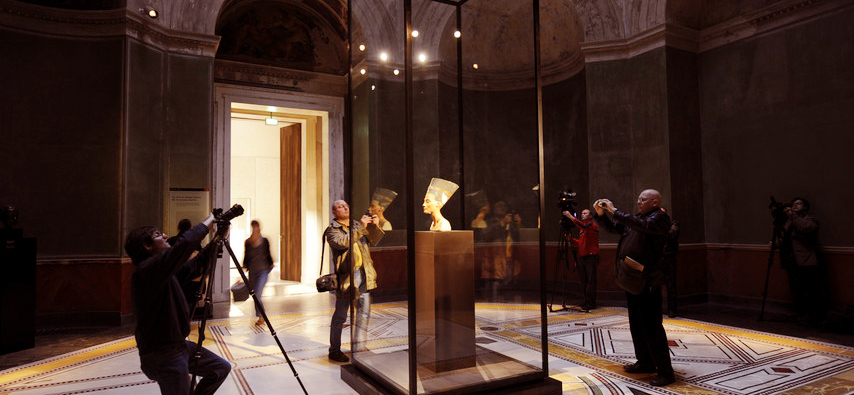
Nofretetes bust in the Berlin Neues Museum

The Egyptians were always afraid of my beauty. 3400 years ago they hated my preference of the sun against all the single, little minor gods they were worshipping. Thats why they banned my statue and burried me deep under ground. After the German archeologists under Ludwig Borchardt excavated me 100 years ago in the meter deep dust in Amarna, and brought me back to sunshine, the Egyption authorities several times attempted to get hold of me. They ordered reviews from French lawyers that should proof how the Germans had violated a contract with Egypt and insidiously betrayed them by highjacking me to Berlin. I have to admit, that my escape from Egypt to Berlin did not happened against my own will: Without exchanging words, both Borchardt and myself understood that the Berlin New Museum would provide a more adequate place for me than an Egyptian dust bin. We were afraid that in Egypt, they again would try to hide my beauty from the public views. Now, 2012, 100 years after my rebirth, they introduce in Egypt the Sharia, ordering every woman to hide her face and her beauty. In Egypt, wouldn't they put me under a hijab or a burka, before showing me to the public ? Or will the Salafists who occupied a couple of parlament seats and some governmental posts attack me altogether, destroy me as they did with other statues in Afghanistan and in Mali, because they fear that people will worship my beauty ? In Berlin in the New Museum, people from all over the world come only to see me, and yes, they worship my beauty. They like me, and I like them, and therefore I will stay in Berlin forever. I am nobodies property, I belong to the entire mankind. But in Berlin they toke always care of me, and they will do so forever. During the bombings of the 2. world war, when the city was turned into a ruin field, they found a saver shelter for me somewhere far away in a mountain village. They were so intrigued by Nofretete, that the emperor Wilhelm II and the East-Germans (who lost me to West-Berlin) both ordered identical copies of myself. I am nobodies property, not the Germans and not the Egyptians. But I am and will stay a Berliner. The local people call me a "Berliner Göre", and although this sounds turkish, it is their slang for "naughty little girl". Although this of course is a (typical Berlin) understatement of my beauty, I can life with it.

Will Keira Knightly leave the train trough the steam ?

Many times Tolstojs novel "Anna Karenina" was brought on the cinema screens, by not so famous film directors, but with actresses who after playing the leading character became movie stars (or were movie stars before already). Sophie Marceau, Jacqueline Bisset, Vivien Leigh and of course Greta Garbo. And now, we have the pleasure to enjoy a more modern Anna Karenina, using state-of-the-art 21st century cinematografic techniques. One of the most intriguing moments in the 1935 movie with Greta Garbo shows her arrival by train in Moscow, when she arises through a steam-cloud and leaves Wronski, who came to the train station only to meet his mother, breathless.
  Before I consider to see the new movie (staring Keira Knightly as Anna and Jude Law as Mr. Karenin and Aaron Taylor-Johnson as Wronski), I first want to see how the train station scene has been set up. If this scene is weak, or a disappointment as compared to Greta Garbos one, I wont see the entire movie.

2.12.12

The Geffen Foundation: from Music money to Medical Research

I was looking for a colleagues work on cancer stem cells today in the internet. Found out that she now works at the David Geffen Medical School of UCLA. I got curious, since I red the name David Geffen already at a research institute in Tel Aviv. So this is what David Geffen, of whom I hardly knew anything untill today, did in his life (apart from founding some of the top centers of biomedical research).
He was born in 1943 as son of a poor tailors family, jewish emigrants from Europe who settled in Brooklyn. Young David attended a couple of colleges but always dropped out before graduation. When he seeked for a job in the then booming music- and entertainment industry, he falsified a letter that wrongly proofed that he graduated from UCLA (hic! This might be the reason for his later generosity in funding the UCLA David Geffen Medical School). This "degree" from UCLA now opened him the career at WMA, where big movie stars such as Chaplin, Clark Gable, Catherine Hepburn, Marilyn Monroe and music stars such as the Rolling stones, Beach Boys, Sonny & Cher were under contract. Later he began his own artists agency and the record label Asylum Records, where he was influential to the success of Crosby, Stills and Nash, Jackson Browne and promoted the career of Bob Dylan, Joni Mitchell, Tom Waits, The Eagles and others. His next record company, Geffen Records, produced Donna Summer, Neil Young, Aerosmith, Peter Gabriel, Nirvana, John Lennon, Yoko Ono and many others. In the 80s, Geffen founded his own movie production and distribution company Geffen Pictures. It produced little gems of cinematography such as "Little Shop of Horrors", "Risky Business", "Beetlejuice", "After Hours", "Men Don't Leave", "M.Butterfly", "Interview with the Vampire", "The Butcher Boy", and (my alltime favorite): "Beavis and Butthead do America". From the money he made here, he co-funded Broadway musicals such as Dreamgirls and Cats. To make clear that Geffen was not simply the lucky guy to discovered a gold-mine for himself (in particular when together with Spielberg and J.Katzenberg he founded DreamWorks Studios), consider where he spend much of his income. He donated large parts of his wealth to organize the UCLA theater Geffen Playhouse. Millioans of $ went to Bill Clintons and Barack Obamas election campaigns and to stop the homo-phobic Proposition 8 in the Californian constituition. His most eminent donations, I think, went to medical research. His 200 mill gift to UCLA to found the medical school was the largest ever privat donation to medical schools in the US.

So I wrote this not to show another typical cases of the american dream to rise from rags to riches. Geffen was not seeking for the quick success and low-risk investments. He was always following a vision. He had an idea that came to him before it became common sense. This might be a common character among the Jews, that its better to sit down and make up your mind and don't go the easy track, but follow your own intention. I think because Jews over the centuries were so often discriminated from starting the easy careers (in gouvernmental administration, academia, army, owning agricultural ground), they developed already very early the skills of converting "crazy" ideas into the business of the future.
But when I said in my early comments above that they not always acted like philantrops, at least there was one big-business where Jews were under-represented: arms production. The entertainment industry and careers in academia obviously absorbed so many of them, that no Jews were left to work in the weapon industry. No point to be ashamed of, I would say.
(A debate on the jewish philantrophy with Bahmani is here)